



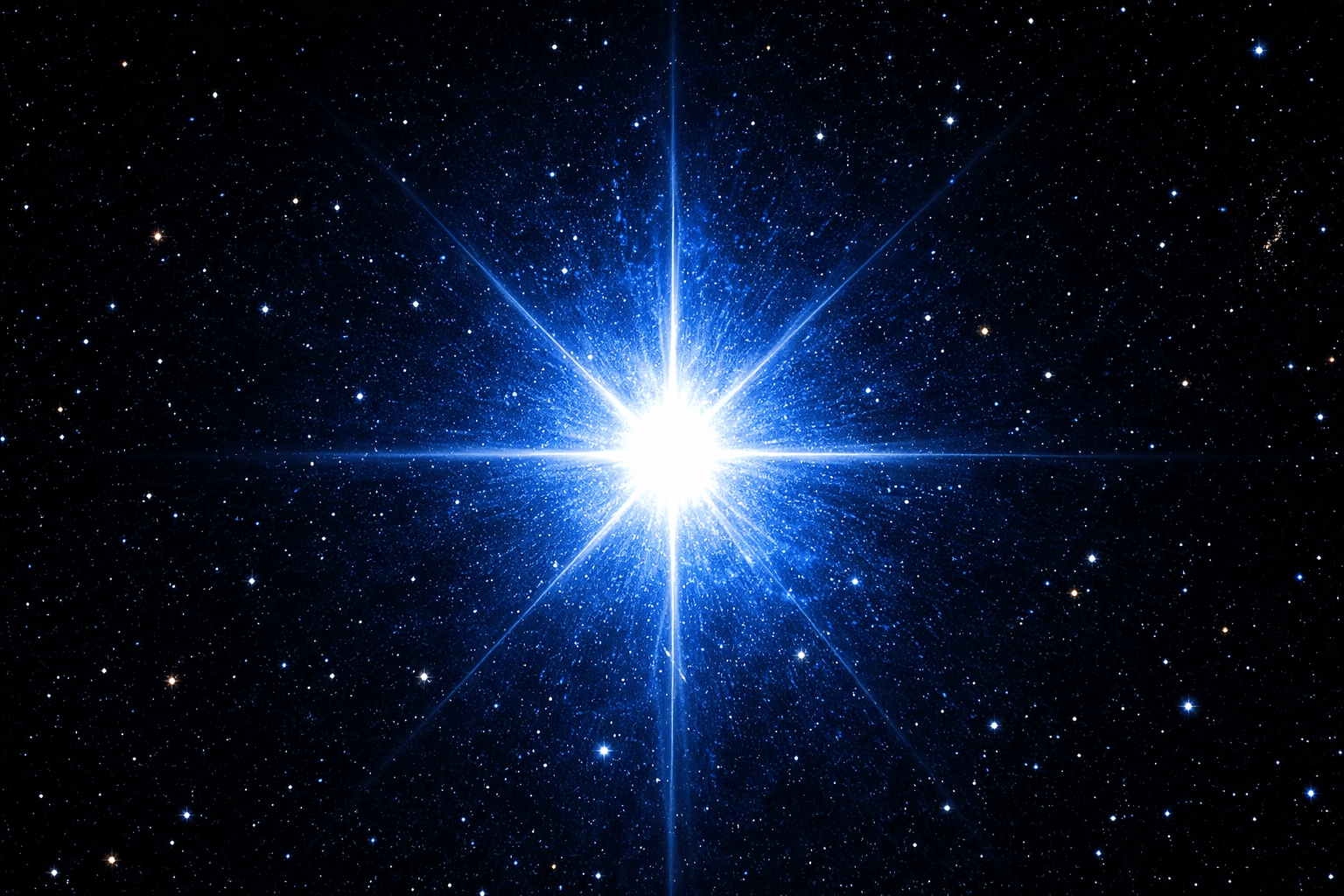
When we look up at the night sky, thousands of stars shine above us, but one star stands out more than the others. That star is Sirius, the brightest star visible from Earth. Because of its extraordinary brightness and historical importance, Sirius has fascinated astronomers, scientists, and civilizations for thousands of years.
This article explores the science, history, and cosmic significance of Sirius, explaining why it remains one of the most important stars in astronomy.
1. What is Sirius?
Sirius is the brightest star in the Earth’s night sky. It is located in the constellation Canis Major, which means “Greater Dog.” Because of this position, Sirius is often called the Dog Star.
The brightness of Sirius is not only because it produces a large amount of light but also because it is relatively close to Earth compared to many other stars.
Key Facts About Sirius
- Distance from Earth: approximately 8.6 light-years
- Stellar system type: Binary star system
- Main star: Sirius A
- Companion star: Sirius B (white dwarf)
- Apparent magnitude: −1.46 (extremely bright)
Because of these characteristics, Sirius appears brighter than any other star we see at night.
2. Why Sirius Appears So Bright
There are two main reasons why Sirius appears brighter than most stars.
1. Relative Proximity to Earth
Sirius is one of the closest stars to our solar system. At about 8.6 light-years away, its light reaches Earth much more strongly than light from distant stars.
2. High Luminosity
The main component, Sirius A, is about 25 times more luminous than the Sun. This high energy output combined with its distance makes it extremely visible in the night sky.
Because of these two factors, Sirius dominates the sky during winter months in many parts of the world.
3. The Binary Nature of Sirius
One fascinating aspect of Sirius is that it is not a single star, but a binary star system.
Sirius A
- A main-sequence star
- Roughly twice the mass of the Sun
- Extremely bright and hot
Sirius B
- A white dwarf star
- Extremely dense
- Roughly the size of Earth but with mass similar to the Sun
Sirius B was once a massive star but eventually exhausted its fuel and collapsed into a white dwarf. This process represents the final evolutionary stage of many stars.
4. Sirius in Ancient Civilizations
Sirius has played an important role in human history for thousands of years.
Ancient Egypt
The ancient Egyptians associated Sirius with the annual flooding of the Nile River. When Sirius first appeared in the morning sky (a phenomenon known as heliacal rising), it signaled the start of the agricultural season.
Greek Astronomy
Greek astronomers connected Sirius with the constellation Canis Major and described it as the Dog Star, which is where the term “dog days of summer” originated.
Cultural Symbolism
In many cultures, Sirius represented:
- prosperity
- seasonal change
- divine guidance
- celestial power
Its brightness made it easy to observe long before telescopes were invented.
5. Scientific Importance of Sirius
Modern astronomy studies Sirius for several scientific reasons.
Stellar Evolution
The Sirius system allows astronomers to study stellar evolution, especially how stars transform into white dwarfs.
Astrophysical Measurements
Because Sirius is nearby and bright, it helps scientists measure:
- stellar temperature
- luminosity
- gravitational interactions
- stellar mass
Binary Star Dynamics
The gravitational relationship between Sirius A and Sirius B provides valuable insights into orbital mechanics and stellar physics.
6. How to Find Sirius in the Sky
Sirius is relatively easy to locate if you know where to look.
Steps to Find Sirius
- Locate the constellation Orion.
- Follow the three stars of Orion’s Belt downward.
- The brightest star you see in that direction is Sirius.
Because of its intense brightness, Sirius often appears to twinkle in multiple colors, especially when it is near the horizon.
7. Interesting Facts About Sirius
- Sirius is about twice the mass of the Sun.
- The temperature of Sirius A is around 9,940 Kelvin.
- Sirius B is one of the first white dwarfs ever discovered.
- The star system is estimated to be 200–300 million years old.
- Sirius is visible from almost every inhabited region of Earth.
These features make Sirius one of the most studied stars in modern astronomy.
Book a Call